Every spring, it happens.
The season winds down. Your kid is tired but happy. You’re tired and significantly broker than you were nine months ago. You’re just starting to see the light at the end of the tunnel — maybe a few weekends to yourselves, maybe a summer that belongs to your family again.
And then the email arrives.
Tryouts are coming up. Commitment decisions are due by [date that is always sooner than you expect]. Roster spots are not guaranteed.
And just like that, you’re back in it.
Welcome to the annual youth soccer hostage situation. Population: every club soccer family in America.
Let’s Call It What It Is
“Hostage” is a strong word. I’m using it on purpose.
Because what happens every year in youth club soccer isn’t a simple registration renewal. It’s a high-pressure, emotionally loaded, financially significant decision that parents are regularly forced to make with incomplete information, artificial urgency, and very little leverage.
Your child has built friendships on this team. They’ve worked with this coach. They know this system. They’ve put in the time, the sweat, the early weekend mornings. And the club knows all of that — and they count on it.
That’s not a coincidence. That’s a business model.
How the Cycle Works (And Why It’s Designed This Way)
Here’s the annual playbook most clubs run, whether they realize it or not:
Step 1: The Tryout Window Opens Early
Clubs schedule tryouts in April or May — often before the current season has even finished. This means you’re being asked to make a decision for next year before you’ve fully processed this year.
Step 2: The Commitment Deadline Creates Urgency
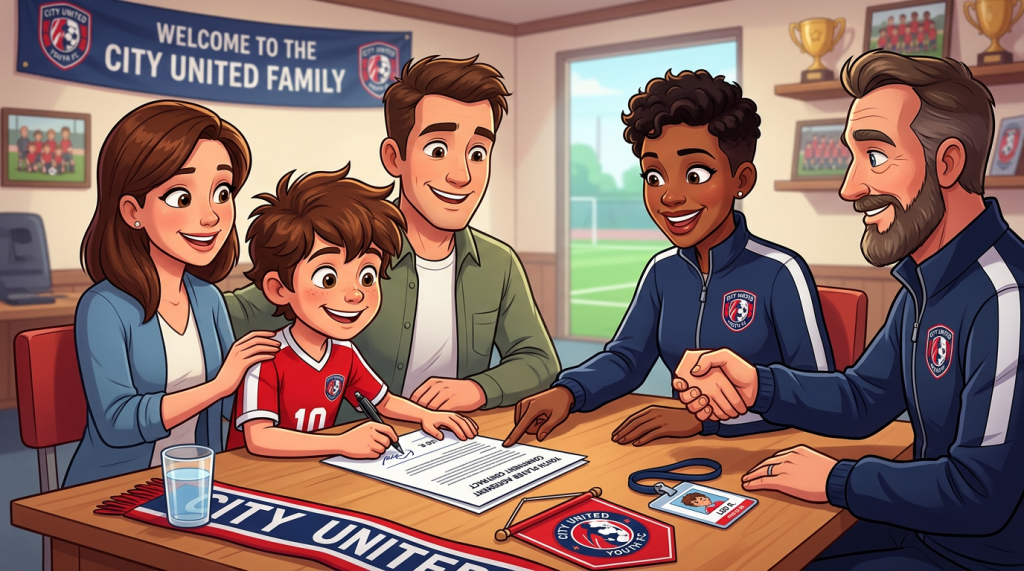
You’re given a narrow window — sometimes 48 to 72 hours after your child makes a team — to commit and pay a deposit. The message, spoken or unspoken: if you don’t decide now, your spot goes to someone else.
Is that always true? Sometimes. Is it also a pressure tactic that benefits the club? Absolutely.
Step 3: No Cross-Shopping Allowed
Many clubs — and even regional governing bodies — have policies that discourage or outright prohibit players from trying out at multiple clubs simultaneously. The rationale given is “fairness.” The effect is that families can’t comparison shop. You go to your current club’s tryout, you get an offer, and you have to decide before you’ve even seen what else is out there.
Step 4: The Financial Lock-In
Deposits are non-refundable. Annual fees are often due up front or on a payment plan that starts immediately. Once you’ve paid, you’re in — whether the season goes well or not, whether your child gets injured or not, whether the coach you signed up for leaves mid-season or not.
Step 5: The Social Pressure Closes the Trap
Your kid doesn’t want to leave their teammates. You don’t want to be the parent who “pulled” their kid. Other families are already re-committing. The coach is talking about how great next year is going to be. Leaving feels disloyal — even when staying doesn’t fully make sense.
And the club gets their roster filled before summer.
The Things Clubs Don’t Tell You at Commitment Time
The coach who recruited your child may not be there next year. Coaching turnover in club soccer is enormous. You’re often committing to a program, not a person — but the person is usually why you joined. Clubs are not required to disclose coaching changes before you commit.
Your child’s role on the team can change completely. New players get added. Positions shift. The kid who was a starter last year may find themselves on the bench after roster moves. You find out after you’ve paid.
“Making the team” at tryouts doesn’t always mean what you think. Some clubs have A teams, B teams, and C teams. Your child makes the team — but which one? The answer sometimes doesn’t come until after commitment. And moving between teams mid-year is complicated at best, impossible at worst.
The fee structure can change year to year. You paid $2,800 last year. Next year’s fee is $3,400. It’s disclosed — eventually — but often after the commitment window has opened and the social pressure is already at full volume.
You have more leverage than they want you to think. Clubs need players. Your child is a paying customer. You are allowed to ask questions, negotiate payment plans, request information about coaching continuity, and take more than 48 hours to make a decision. The urgency is often manufactured.
The “We’re a Family” Language Is Doing a Lot of Work
This one deserves its own section.
Most clubs are very good at building genuine community — and that community is real and valuable. The friendships your kid makes, the team bonds, the shared experiences — that stuff matters.
But “we’re a family” can also be used to make parents feel like they owe the club loyalty that the club doesn’t necessarily return. Families don’t charge you a non-refundable deposit to come to Thanksgiving. Families don’t fill your kid’s roster spot if you don’t respond within 72 hours.
When a club invokes family language, ask yourself: does this relationship have the reciprocity that word implies? Or is “family” doing the emotional work of keeping you from asking hard financial questions?
Both things can be true at once: the community can be genuine and the business practices can be worth scrutinizing.
What Parents Actually Fear (And Why Clubs Know It)
The dirty secret of the annual commitment cycle is that it runs on fear. Specifically:
Fear that your child will fall behind. If you take a season off, will they lose ground? Will the other kids surpass them? Will opportunities close a little bit?
Fear of your child’s disappointment. Nobody wants to be the parent who took their kid off the team. The look on their face is a powerful thing.
Fear of social exclusion. Club soccer friendships are tight. Leaving the team can feel like leaving the friend group.
Fear of making the wrong call. What if you switch clubs and it’s worse? What if this was the year everything clicked and you missed it?
Clubs don’t manufacture these fears — but they don’t work very hard to calm them either. The annual tryout and commitment cycle is built in a way that activates all of them right on schedule, every year.
What You Can Actually Do About It
You’re not as powerless as the system wants you to feel. Here’s how to reclaim some control:
Give yourself permission to look around. Tryout at other clubs. Yes, even if your current club frowns on it. You are a consumer making a significant financial decision. Comparison shopping is not disloyal — it’s responsible.
Ask direct questions before you commit.
- Is the current coach under contract for next year?
- What is the full fee structure, including all tournament costs?
- What is the refund policy if my child is injured?
- How are roster changes handled mid-season?
If a club gets defensive about these questions, that is information.
Push back on the deadline. Ask for more time. Seriously. The worst they can say is no. Many clubs will give you an extra few days if you ask directly and professionally. If they won’t, ask yourself what that tells you about how they handle conflict and communication during the season.
Read the contract. Most clubs have a player/family agreement. Read it before you sign it. Know what you’re committing to, what the cancellation terms are, and what happens if circumstances change.
Have the real conversation with your kid. Not “do you want to keep playing soccer” — but: Do you love this team? This coach? These specific friends? Or are you staying because it’s comfortable? Kids can handle more nuance than we give them credit for.
Know your walk-away number. Decide before tryout season what your budget ceiling is. If the fees come in above it, you have your answer — and you’ve made it before the emotional pressure hits.
The Bigger Picture
Youth sports in America has become a multi-billion dollar industry. Club soccer alone generates enormous revenue off the backs of families who are investing in their children’s development and joy.
That’s not inherently bad. Good clubs do great work. Great coaches change kids’ lives. The experience is genuinely worth it for many families.
But the business model of most clubs depends on retention — and retention is easier when parents feel they have no choice. The annual commitment cycle is perfectly engineered to keep families in, keep money flowing, and make leaving feel like a bigger deal than it is.
It’s worth naming that. Not to blow up the system, but to walk into it with your eyes open.
Your kid is not hostage to any club. You can leave. You can switch. You can take a season off. You can ask hard questions. You can say the deposit deadline doesn’t work for your family and see what happens.
The worst outcome is usually that you have to find a new team.
And there are always new teams.
Bottom Line
The annual soccer club commitment cycle is designed to minimize your choices and maximize club retention — and it works because it runs on real emotions: love for your kid, fear of missing out, and the very human desire not to rock the boat.
You’re allowed to rock the boat.
Ask the questions. Read the contract. Give yourself permission to shop around. Make the decision that’s right for your child and your family — not the one that’s easiest for the club.
Your kid plays soccer because they love the game.
The game will still be there, whatever you decide.
⚽
Have a club commitment story — good, bad, or “I can’t believe they did that”? Tell me in the comments. This is a safe space for all of it.




Leave a Reply