Because honestly, if I start explaining the fees, the travel, the politics, the “optional” trainings, and the fact that I now own more sideline chairs than actual dining chairs… we’ll be here all day.
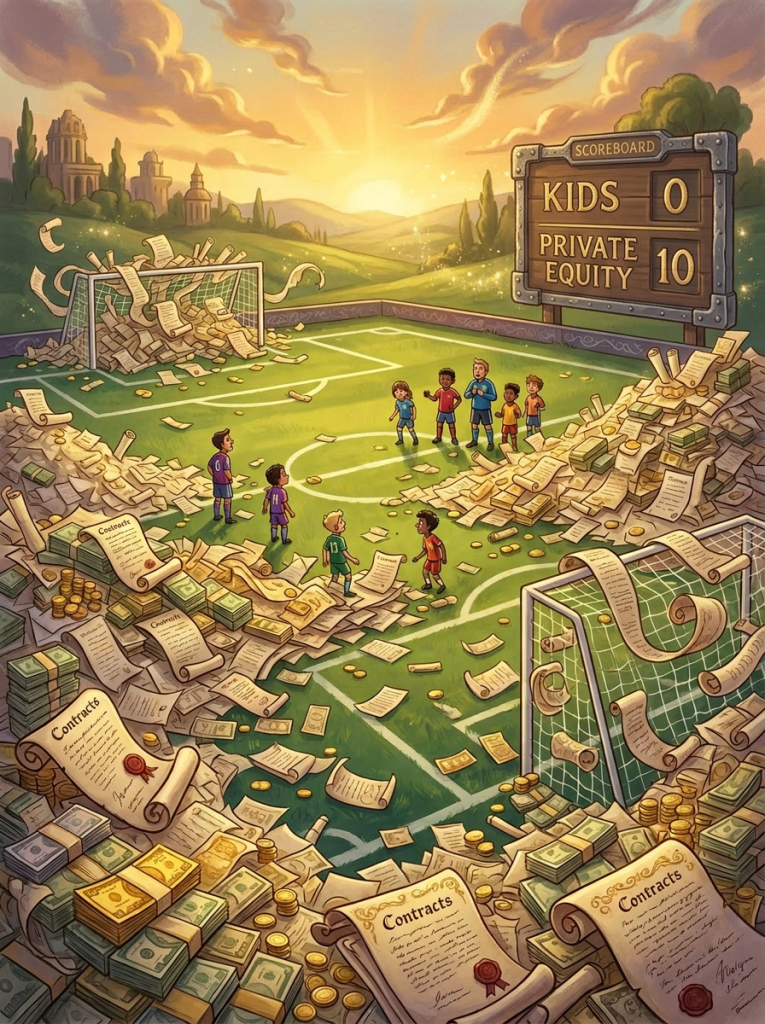
At some point, youth soccer quietly stopped being… youth soccer. One minute we were signing our kids up for a Saturday morning rec league, and the next we were involuntary participants in a full‑scale, multi‑billion‑dollar ecosystem that somehow has us driving across state lines for a game between fourth graders.
And the wild part?
We all just went along with it.
The Industry Nobody Asked For (But Definitely Pays For)
Let’s talk numbers, because the numbers are wild.
Parents in the U.S. now spend over $40 billion annually on youth sports — yes, billion with a B. MSN
And soccer? It’s one of the fastest‑rising cost culprits.
The average American family spends $1,016 per year on their child’s primary sport, a 46% jump since 2019. projectplay.org
But that’s the average — and averages hide the real story.
In youth soccer specifically:
- Recreational soccer: $125–$400/year
- Competitive club soccer: $2,500–$8,000/year
- Elite levels (ECNL, MLS NEXT, GA): $8,000–$20,000+ per year when you include travel, gear, and showcases. solsticefc.com
That’s not a cost curve. That’s a cliff.
And families are falling off it in droves.
The Parent Pressure Cooker (Now With Inflation)
No one wants to be that parent — the one who “holds their kid back.” So we all get sucked into the same vortex:
“If she doesn’t play year‑round, she’ll fall behind.”
“If he doesn’t get on the right team now, he’ll never catch up.”
“If we skip this tournament, the coach will think we’re not committed.”
Meanwhile, travel costs alone have risen 46% since 2019, with some families spending $10,000–$13,000 just on travel for a single sport. MSN
Suddenly you’re discussing “development pathways” and “ID sessions” for children who still believe in Santa — while quietly wondering if you should open a second checking account just for tournaments.
Meanwhile, the Kids… (The Part No One Wants to Admit)
Here’s the part that stings:
Somewhere in all the noise, the kids stopped having fun.
And the research backs it up.
The American youth soccer system is increasingly built around short‑term performance over long‑term development, creating players who are less creative, more stressed, and more likely to burn out. LinkedIn
Why?
Because clubs and coaches operate in a market where retention depends on winning — not developing.
So the fastest kid gets stuck at center back forever.
The biggest kid plays every minute.
Build‑up play gets replaced with “just boot it.”
And creativity? Expression? Risk‑taking?
Those get coached right out of them.
The result: a narrower, less imaginative talent pool — despite millions of kids playing.
The Quiet Truth (Now With Context)
This whole thing only works because parents keep feeding it.
And we feed it because we’re scared not to.
But youth soccer was never supposed to be a pipeline.
It was supposed to be… childhood.
So maybe the real rebellion isn’t pulling your kid out or burning the jerseys.
Maybe it’s remembering that:
- It’s okay to choose balance.
- It’s okay to say no.
- It’s okay to let your kid be average, happy, and home for dinner.
Because if we’re being honest, the only people who truly benefit from this racket are the ones cashing the checks — not the kids who just want to play.




Leave a Reply